



The Complete Guide to Service Dogs
La Guía Completa de Perros de Servicio
Everything you need to know about service dogs — what they do, your legal rights, training options, the difference between a service dog and an ESA, how documentation works, and how to spot scams. Written so anyone can understand.
Todo lo que necesita saber sobre perros de servicio — qué hacen, sus derechos legales, opciones de entrenamiento, la diferencia entre un perro de servicio y un ESA, cómo funciona la documentación y cómo detectar estafas.


What Makes a Dog a “Service Dog”?
¿Qué Hace que un Perro Sea un “Perro de Servicio”?
A service dog is a dog that has been individually trained to perform specific tasks that directly help a person with a disability. That’s the definition that matters under the law — specifically, the Americans with Disabilities Act (ADA). It’s not about what the dog looks like, what breed it is, or whether it wears a vest. It’s about what the dog has been trained to do.
Un perro de servicio es un perro que ha sido entrenado individualmente para realizar tareas específicas que ayudan directamente a una persona con una discapacidad. Esa es la definición que importa bajo la ley — específicamente, la Ley de Estadounidenses con Discapacidades (ADA). No se trata de cómo se ve el perro, de qué raza es, ni de si lleva un chaleco. Se trata de lo que el perro ha sido entrenado para hacer.
For example, a dog that is trained to sense when its owner is about to have a panic attack and then applies deep pressure therapy by laying across the person’s lap — that’s a service dog. A dog that is trained to detect changes in blood sugar and alert a diabetic person before a dangerous episode — that’s also a service dog. The task is what gives the dog its legal status, not a certificate or ID card.
Por ejemplo, un perro entrenado para detectar cuándo su dueño está a punto de tener un ataque de pánico y luego aplica terapia de presión profunda — eso es un perro de servicio. Un perro entrenado para detectar cambios en el azúcar en sangre y alertar a una persona diabética antes de un episodio peligroso — eso también es un perro de servicio. La tarea es lo que le da al perro su estatus legal, no un certificado o tarjeta.
There is no size, breed, or age requirement. Golden retrievers, Labrador retrievers, German shepherds, poodles, and even small breeds like Cavalier King Charles spaniels can all be service dogs. What matters is temperament, training, and the ability to reliably perform the task in public settings.
No hay requisito de tamaño, raza o edad. Golden retrievers, Labrador retrievers, pastores alemanes, caniches e incluso razas pequeñas como Cavalier King Charles spaniels pueden ser perros de servicio. Lo que importa es el temperamento, el entrenamiento y la capacidad de realizar la tarea en público.
Service Dog vs. ESA vs. Therapy Dog
Perro de Servicio vs. ESA vs. Perro de Terapia
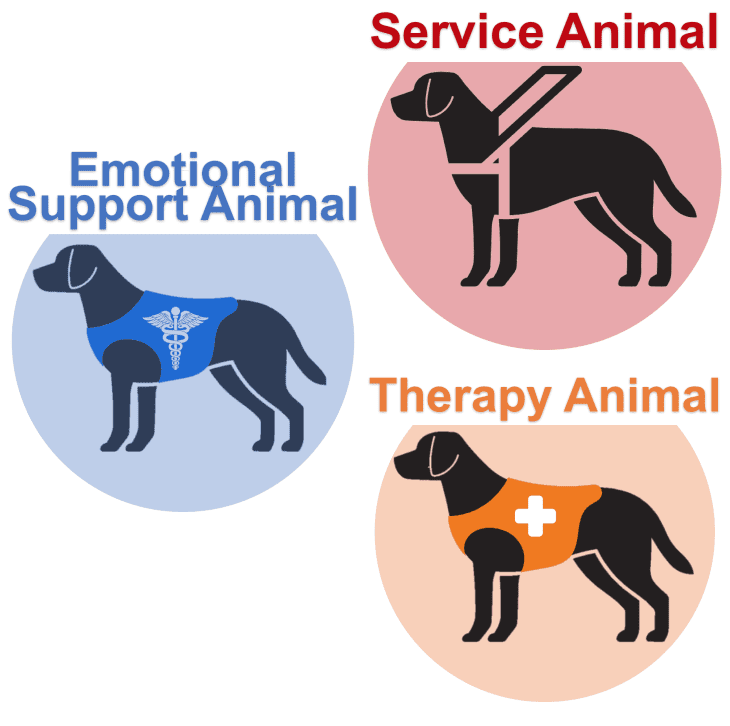
This is one of the most misunderstood topics in the animal-assisted support world. These three categories are very different, have different legal protections, and serve different purposes. Understanding which one applies to you is the most important first step.
Este es uno de los temas más malinterpretados. Estas tres categorías son muy diferentes, tienen diferentes protecciones legales y sirven diferentes propósitos. Entender cuál se aplica a usted es el primer paso más importante.
| Feature | Service Dog | ESA | Therapy Dog | Característica | Perro de Servicio | ESA | Perro de Terapia |
|---|---|---|---|---|---|---|---|
| Task-trained? | Yes — required | No | Varies | ¿Entrenado? | Sí — requerido | No | Varía |
| Public access (ADA)? | Yes — all public places | No | By invitation only | ¿Acceso público? | Sí — todos los lugares | No | Solo por invitación |
| Housing rights (FHA)? | Yes | Yes | No | ¿Vivienda (FHA)? | Sí | Sí | No |
| Air travel? | Yes — in cabin free | Airline pet policy | No | ¿Viaje aéreo? | Sí — cabina gratis | Política mascotas | No |
| Who benefits? | The handler | The owner | Others (patients, students) | ¿Quién beneficia? | El manejador | El dueño | Otros (pacientes) |
Many people searching for “therapy dog certification” actually need ESA or PSD documentation for their own mental health support — not volunteer therapy work. If you’re looking for housing rights or public access for your own dog, you likely need a service dog or emotional support animal designation, not therapy dog certification. Learn more about the differences at 🎓 CertifyTherapyDog.org and explore ESA housing rights at 🏠 Service-Pet.org.
Muchas personas que buscan “certificación de perro de terapia” en realidad necesitan documentación de ESA o PSD para su propio apoyo de salud mental. Si busca derechos de vivienda o acceso público para su propio perro, probablemente necesita una designación de perro de servicio o animal de apoyo emocional. Aprenda más en 🎓 CertifyTherapyDog.org y explore los derechos de vivienda ESA en 🏠 Service-Pet.org.

Who Can Have a Service Dog?
¿Quién Puede Tener un Perro de Servicio?
To qualify for a service dog, two things must be true: (1) you have a disability — a physical or mental condition that substantially limits one or more major life activities — and (2) the dog has been trained to do a specific task that directly relates to that disability. The disability doesn’t need to be visible. In fact, the fastest-growing category of service dogs today is psychiatric service dogs (PSDs), which help people with conditions like PTSD, severe anxiety, major depressive disorder, bipolar disorder, autism spectrum disorder, and more.
Para calificar, dos cosas deben ser ciertas: (1) usted tiene una discapacidad — una condición física o mental que limita sustancialmente una o más actividades principales de la vida — y (2) el perro ha sido entrenado para hacer una tarea específica que se relaciona directamente con esa discapacidad. La discapacidad no necesita ser visible. La categoría de más rápido crecimiento hoy son los perros de servicio psiquiátrico (PSDs).
Qualifying conditions include but are not limited to: anxiety disorders, PTSD, depression, panic disorder, obsessive-compulsive disorder, agoraphobia, social anxiety, traumatic brain injury, seizure disorders, diabetes, visual impairment, hearing loss, mobility limitations, multiple sclerosis, and autism. If your condition meaningfully affects your ability to sleep, work, concentrate, leave the house, or manage daily activities, you may qualify. For a deeper understanding of psychiatric service dogs specifically, visit 🐾 MyPSD.org.
Las condiciones que califican incluyen: trastornos de ansiedad, TEPT, depresión, trastorno de pánico, TOC, agorafobia, ansiedad social, lesión cerebral traumática, trastornos convulsivos, diabetes, discapacidad visual, pérdida de audición, limitaciones de movilidad, esclerosis múltiple y autismo. Si su condición afecta su capacidad para dormir, trabajar, concentrarse, salir de casa o manejar actividades diarias, puede calificar. Para más sobre PSDs, visite 🐾 MyPSD.org.
What Tasks Do Service Dogs Perform?
¿Qué Tareas Realizan los Perros de Servicio?
The task is the heart of what makes a service dog a service dog. Under the ADA, the dog must be trained to take a specific action when needed. Simply providing comfort by being present does not count as a task — that’s what makes an ESA different from a service dog. Here are the two main categories:
La tarea es el corazón de lo que hace que un perro de servicio sea un perro de servicio. Bajo la ADA, el perro debe estar entrenado para tomar una acción específica cuando sea necesario. Simplemente proporcionar confort con su presencia no cuenta como tarea.
🦮 Physical / Mobility Tasks
🦮 Tareas Físicas / de Movilidad
Guiding a person who is blind or visually impaired. Bracing or providing counterbalance for someone with mobility challenges. Pulling a wheelchair up ramps or inclines. Opening and closing doors using a tug mechanism. Retrieving dropped items like medications, keys, or a phone. Pressing elevator buttons or light switches. Alerting a deaf or hard-of-hearing person to important sounds like doorbells, alarms, or a crying child.
Guiar a una persona ciega o con discapacidad visual. Apoyar o proporcionar contrapeso para alguien con desafíos de movilidad. Tirar de una silla de ruedas por rampas. Abrir y cerrar puertas. Recuperar objetos caídos como medicamentos, llaves o un teléfono. Presionar botones de ascensor. Alertar a una persona sorda sobre sonidos importantes.
🧠 Psychiatric / Invisible Disability Tasks
🧠 Tareas Psiquiátricas / Discapacidad Invisible
Performing deep pressure therapy (DPT) during panic attacks or PTSD episodes by laying across the handler’s body. Interrupting self-harming behaviors by nudging or pawing. Creating physical space in crowded areas for someone with agoraphobia. Waking a handler from night terrors or nightmares. Reminding a handler to take medication at scheduled times. Alerting to rising anxiety levels before a full episode begins. Guiding a disoriented handler to safety during dissociative episodes.
Realizar terapia de presión profunda (DPT) durante ataques de pánico o episodios de TEPT. Interrumpir comportamientos autolesivos empujando o dando golpecitos. Crear espacio físico en áreas concurridas para alguien con agorafobia. Despertar de terrores nocturnos. Recordar tomar medicación. Alertar sobre niveles crecientes de ansiedad. Guiar a un manejador desorientado a seguridad durante episodios disociativos.
How Are Service Dogs Trained?
¿Cómo se Entrenan los Perros de Servicio?
There are two main pathways to training a service dog, and both are equally valid under federal law. There is no government certification program, no mandatory school, and no required number of training hours specified in the ADA. What the law cares about is the result — can the dog reliably perform its trained task in public?
Hay dos caminos principales para entrenar un perro de servicio, y ambos son igualmente válidos bajo la ley federal. No hay programa de certificación gubernamental, no hay escuela obligatoria y no hay número requerido de horas de entrenamiento. Lo que importa es el resultado.
Organization-trained: A professional service dog organization raises and trains the dog from puppyhood, then matches the dog with a handler. Programs like these often have long waitlists (sometimes 1–3 years) and can cost anywhere from $15,000 to $50,000 or more. Many organizations offer financial assistance or provide dogs free of charge to qualifying individuals, especially veterans and first responders.
Entrenado por una organización: Una organización profesional cría y entrena al perro desde cachorro, luego lo empareja con un manejador. Estos programas a menudo tienen largas listas de espera (1–3 años) y pueden costar desde $15,000 hasta $50,000 o más. Muchas ofrecen asistencia financiera, especialmente para veteranos.
Owner-trained: You train your own dog yourself or work with a professional trainer. This is completely legal and increasingly common, especially for psychiatric service dogs. You choose the dog, you choose the training methods, and you work at your own pace. The advantage is flexibility and lower cost. The challenge is that it requires consistency, patience, and a dog with the right temperament. Not every dog is suited to be a service dog — even well-trained pets can wash out if they’re too reactive, anxious, or easily distracted in public settings.
Entrenado por el dueño: Usted entrena a su propio perro o trabaja con un entrenador profesional. Es completamente legal y cada vez más común, especialmente para PSDs. La ventaja es flexibilidad y menor costo. El desafío es que requiere consistencia, paciencia y un perro con el temperamento adecuado. No todos los perros son aptos.
Your Legal Rights: The 4 Federal Laws That Protect You
Sus Derechos Legales: Las 4 Leyes Federales Que Lo Protegen
Service dog handlers are protected by multiple federal laws. Understanding which law applies to your situation is critical — whether you’re at a restaurant, apartment building, airport, or workplace. Here’s a plain-language breakdown:
Los manejadores de perros de servicio están protegidos por múltiples leyes federales. Entender cuál ley se aplica es crítico — ya sea en un restaurante, edificio, aeropuerto o lugar de trabajo.
🏛️ ADA — Public Access
🏛️ ADA — Acceso Público
The Americans with Disabilities Act says your service dog can go anywhere the public can go — restaurants, stores, hotels, hospitals, movie theaters, gyms, and more. Businesses cannot charge extra fees or require you to sit in a separate area.
La ADA dice que su perro de servicio puede ir a cualquier lugar público. Los negocios no pueden cobrar tarifas adicionales ni exigirle sentarse en un área separada.
🏠 FHA — Housing
🏠 FHA — Vivienda
The Fair Housing Act requires landlords to make “reasonable accommodations” for service dogs and ESAs — even in no-pet buildings. They cannot charge pet deposits or fees. This applies to nearly all housing types.
La Ley de Vivienda Justa requiere acomodaciones razonables para perros de servicio y ESAs — incluso en edificios sin mascotas. No pueden cobrar depósitos por mascotas.
✈️ ACAA / DOT — Air Travel
✈️ ACAA / DOT — Viaje Aéreo
The Air Carrier Access Act and DOT regulations allow trained service dogs to fly in the aircraft cabin at no extra charge. Airlines may require a DOT Service Animal Transportation Form submitted 48 hours before departure.
La ACAA y las regulaciones del DOT permiten que los perros de servicio vuelen en la cabina sin cargo adicional. Las aerolíneas pueden requerir un formulario del DOT enviado 48 horas antes.
💼 EEOC — Workplace
💼 EEOC — Lugar de Trabajo
The Equal Employment Opportunity Commission enforces workplace accommodations under the ADA. Your employer must allow your service dog as a reasonable accommodation unless it creates an undue hardship on the business.
La EEOC aplica acomodaciones en el trabajo bajo la ADA. Su empleador debe permitir su perro de servicio como acomodación razonable.
In addition to these federal protections, most states have their own service dog laws that provide additional rights. Some states have stricter penalties for businesses that deny access, and some extend protections to emotional support animals in ways federal law does not. You can look up your specific state’s laws at 🗺️ USServicePet.org. If you believe your rights have been violated, visit our Know Your Rights page or reach out to 🇺🇸 ServiceDogOfAmerica.org for advocacy support.
Además de estas protecciones federales, la mayoría de los estados tienen sus propias leyes que proporcionan derechos adicionales. Consulte las leyes de su estado en 🗺️ USServicePet.org. Si cree que sus derechos han sido violados, visite nuestra página Conozca Sus Derechos o comuníquese con 🇺🇸 ServiceDogOfAmerica.org.
The Two-Question Rule (ADA)
La Regla de las Dos Preguntas (ADA)
When you bring your service dog into a business, the staff are allowed to ask only two questions: (1) Is this a service animal required because of a disability? (2) What work or task has this dog been trained to perform? That’s it. They cannot ask about the nature of your disability, request medical documentation, ask the dog to demonstrate its task, or require any kind of certification or registration.
Cuando lleva su perro de servicio a un negocio, el personal solo puede hacer dos preguntas: (1) ¿Es este un animal de servicio requerido por una discapacidad? (2) ¿Qué tarea ha sido entrenado a realizar? No pueden preguntar sobre su discapacidad, solicitar documentación médica ni requerir certificación.
A good, calm response is all you need: “Yes, this is my service dog. He is trained to perform deep pressure therapy during anxiety episodes.” Keep it short, keep it task-focused, and don’t feel pressured to share more. If they persist or deny access, calmly document the date, time, location, and names of the people involved — and file a complaint. You have the right to be there.
Una respuesta calmada es todo lo que necesita: “Sí, este es mi perro de servicio. Está entrenado para realizar terapia de presión profunda durante episodios de ansiedad.” Si persisten o niegan el acceso, documente la fecha, hora, ubicación y nombres — y presente una queja.
Documentation: What Actually Helps
Documentación: Lo Que Realmente Ayuda
Let’s be clear: no federal law requires registration, certification, or an ID card for a service dog. The ADA specifically states this. However, in real life, having professional documentation from a licensed mental health provider makes things significantly easier. Landlords cooperate faster. Airlines process your requests smoother. Businesses are less likely to challenge you. And if a dispute ever escalates, having a clinical letter on file from a licensed provider is powerful evidence in your favor.
Seamos claros: ninguna ley federal requiere registro, certificación o tarjeta de identificación. La ADA lo establece específicamente. Sin embargo, en la vida real, tener documentación profesional de un proveedor licenciado facilita todo significativamente. Los propietarios cooperan más rápido. Las aerolíneas procesan solicitudes más suavemente. Y si una disputa escala, tener una carta clínica es evidencia poderosa a su favor.
Helpful documentation includes: a signed clinical letter from a licensed mental health professional on their letterhead, a professional photo ID card for your dog, registration in a verifiable national database, and veterinary health records. You can verify whether a dog has been properly registered through our national database at 🔍 OfficialServiceAnimal.com.
La documentación útil incluye: una carta clínica firmada en papel membretado, una tarjeta de identificación con foto para su perro, registro en una base de datos nacional verificable y registros veterinarios. Puede verificar si un perro ha sido registrado en 🔍 OfficialServiceAnimal.com.
Common Myths — Debunked
Mitos Comunes — Desmentidos
“Service dogs must be registered with the government.”
“Los perros de servicio deben registrarse con el gobierno.”
There is no government registry for service dogs in the United States. Registration is voluntary and no business or landlord can legally require it.
No hay registro gubernamental para perros de servicio en EE.UU. El registro es voluntario y nadie puede exigirlo legalmente.
“Only certain breeds can be service dogs.”
“Solo ciertas razas pueden ser perros de servicio.”
Any breed can be a service dog. The ADA does not restrict by breed, size, or weight. What matters is training and behavior.
Cualquier raza puede ser un perro de servicio. La ADA no restringe por raza, tamaño o peso.
“Service dogs must wear a vest or have an ID.”
“Los perros de servicio deben usar chaleco o tener identificación.”
Vests, harnesses, and IDs are not required by law. Many handlers use them for convenience and to reduce confrontations, but they are entirely optional.
Los chalecos, arneses e identificaciones no son requeridos por ley. Son completamente opcionales.
“Emotional support animals have the same rights as service dogs.”
“Los animales de apoyo emocional tienen los mismos derechos que los perros de servicio.”
ESAs have housing protections under the Fair Housing Act but do not have public access rights under the ADA, and as of 2021, no longer have guaranteed air travel rights under federal law.
Los ESAs tienen protecciones de vivienda bajo la FHA pero no tienen derechos de acceso público bajo la ADA, y desde 2021, no tienen derechos garantizados de viaje aéreo.
“You need a doctor’s note to have a service dog.”
“Necesita una nota de médico para tener un perro de servicio.”
The ADA does not require documentation for public access. However, a clinical letter is needed for housing (FHA requires it for ESAs), helpful for air travel, and highly recommended for avoiding disputes. A licensed mental health provider’s letter carries real weight.
La ADA no requiere documentación para acceso público. Sin embargo, una carta clínica es necesaria para vivienda (la FHA la requiere para ESAs), útil para viaje aéreo y muy recomendable para evitar disputas.
Ready to Get Started?
¿Listo Para Comenzar?
If you think you may qualify for a service dog or emotional support animal, the first step is simple: take our free, anonymous 3-minute screening. There’s no credit card required, no obligation, and you can stop at any time. The screening helps determine if you may benefit from a clinical evaluation by one of our licensed mental health providers. If you qualify, you can receive same-day documentation — including a signed clinical letter, professional photo ID, and national database registration.
Si cree que puede calificar, el primer paso es simple: tome nuestra evaluación gratuita, anónima de 3 minutos. No se requiere tarjeta de crédito, no hay obligación, y puede detenerse en cualquier momento. Si califica, puede recibir documentación el mismo día — carta clínica firmada, identificación con foto y registro en base de datos nacional.
We’ve helped over 50,000 people since 2016 through our network of 501(c)(3) nonprofit organizations. Every clinical letter comes from a real, licensed mental health professional — not an automated system. You can learn more about our full network of resources at 📖 Service-Animal.org.
Hemos ayudado a más de 50,000 personas desde 2016 a través de nuestra red de organizaciones sin fines de lucro 501(c)(3). Cada carta clínica proviene de un profesional de salud mental real y licenciado. Aprenda más en 📖 Service-Animal.org.
TheraPetic Healthcare Provider Group
Grupo de Proveedores de Salud TheraPetic